This guide will explain how to perform linearprogramming in Excel using Solver. We can use linearprogramming to find the optimal solution for a problem with multiple constraints.
Use Solver to find an optimal (maximum or minimum) value for a formula in one cell—called the objective cell—subject to constraints, or limits, on the values of other formula cells on a worksheet.
In this article, we have covered the basics of linear programming and how to use Excel Solver to solve linear programming problems. We have also discussed advanced techniques for optimizing solutions, including sensitivity analysis and constraint modification.
LinearProgramming is a widely used mathematical technique designed to help managers and engineers in planning and decision making relative to resource allocation. Linearprogramming (LP) model essentially consists of 3 components. This article shows how to develop LP model in Excel.
By building Excel models for LPP, you can transform complicated decision-making scenarios into clear, data-driven solutions that optimize outcomes while respecting real-world constraints.
LinearProgramming is one of the most interesting features of applied mathematics. We can solve linearprogramming through Excel. But Excel has no built-in function or feature to perform this. There are two ways to perform linearprogramminginExcel, and we will discuss them in detail here.
With the Solver add-in in Microsoft Excel, users may find the solution for an integer linearprogram rapidly. We will walk through this process in simple, straightforward steps today. The final portion of this tutorial will also see an example of a mixed-integer linearprogramming problem. So, let's begin without delay.
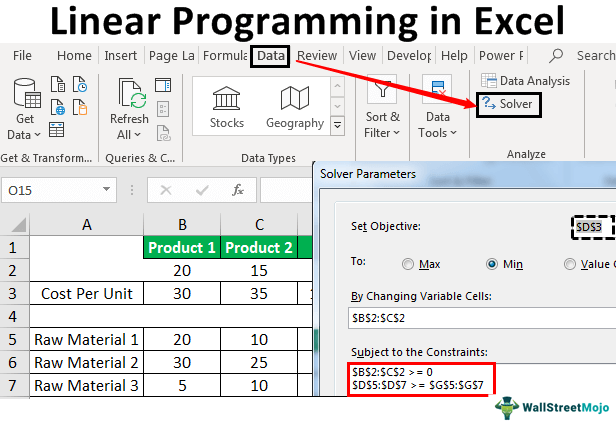 Guide to Linear Programming in Excel. Here we discuss how to solve the linear programming problem in excel solver with example & downloadable template.